Sunday

Lake Cloverdale: An Ice Age Lake in New Mexico’s Bootheel

A number of playas can be found in the valleys of southern New Mexico and Arizona and these Pleistocene lake beds are best known as migratory bird stops. In the winter these lake beds still hold water and the shallow lakes form with the winter rains attracting many species of water fowl. In the bootheel of New Mexico there are 2 lakebeds, Lake Cloverdale and the playa that runs down the center of Playas valley.

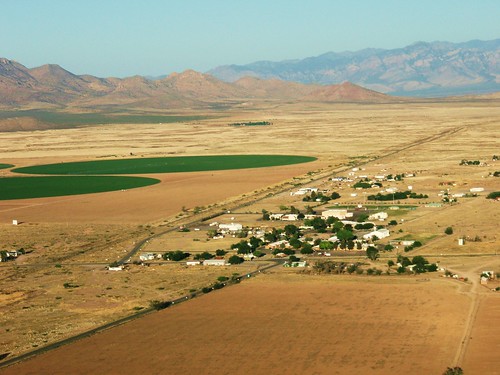
Lake Cloverdale sits at the base of Animas valley and extends into Mexico. Covering an area of about 102 km2 (27 square miles), Lake Cloverdale is now only a grassy field with scattered cattle tanks. The shoreline of this shallow pluvial lake is clearly visible in the photographs and based on the elevation change the lake was no more than 10-20 feet deep at the margin. Several stream beds from the surrounding mountains, including Cloverdale Creek were part of the lake’s recharge system as well as springs like Cienega Springs which brought ground water into the lake. It now sits abandoned by the water as the climate dried after the last ice age and is now the largest grass landing field I can think of, although it sits on the 320,000 acre Diamond A Ranch (still known locally as the Grey Ranch).

Click to enlarge photographs


Looking south down Animas valley along the drainage toward Lake Cloverdale.


Looking southwest from the north shore of Lake Cloverdale across the former lake.

View from the south looking north at the former shoreline of Lake Cloverdale.

Looking north at the shoreline, showing the boat ramp on Lake Cloverdale.

Friday

Desert Arteries

Water is the life blood of the desert. This image from Playas Valley captures the drainage patterns which resemble the arteries and smaller arterioles in the body but here feeding the desert. This drainage leads into the Playa that runs down the center of the valley. Note the power poles for scale, or go to here to see it on the satellite map. The image is on the upper right on the satellite map.


Click to enlarge

Thursday

From the Sky Gypsies Studios

In many cultures the creation of pottery involves a spiritual aspect and the finished product is not only an expression of the individual potter and each piece acquires a spirit of its own. But what happens when the ceramic is broken and discarded, its pieces scattered, when it becomes household trash? It no longer has a story to tell, it is no longer a reflection of the potters hands, it's spirit is lost.

Household trash tells a great deal about people, especially if relationships can be recreated from carefully collected and documented trash. But when the detritus of peoples lives has no context what information remains except descriptive? How big, what colors, what materials, what paints were used, and what designs appear on each piece. But even a statistical analysis is questionable since information on the spacial relationships is not available. In more general terms, how is a new story created, how does the piece gain a new context? In other words how do you make these pieces of household trash live again.

It is quite simple, a collaborative effort across space and time. A collaboration between the potters who created the ceramics and Artists today. By recycling and recombining the fragments to express a different idea a new story and context is created.

These pieces of art represent this collaboration and express the desire to give new meaning and life to material that would otherwise be forgotten.

Reverse Stratigraphy
Click to enlarge

The title is descriptive. The piece at the base is younger than the top partial reconstruction.

Some Assembly Required

Click to enlarge

All the fragments belong to the same original ceramic piece. During reconstruction one of the fitted pieces refused to fit when glued. It stubbornly remained slightly separate and was left that way inspiring the title. The other small pieces, although belonging to the same ceramic do not fit on the reconstruction.

In and Out Patterns in Mimbres

Click to enlarge

A fragment of a classic Mimbres black on white geometic bowl. Painted on the interior it differs from the fragment at the base, also Mimbres, but where the decoration appeared on the outside of the original ceramic, inspiring the title In and Out Patterns in Mimbres.

This is old trash that has been recycled and as such requires a disclaimer. All materials were recovered from private land by the landowner over a period of about 20 years and do not violate state or national laws regarding antiquities.

Monday

A Threat to National Security or Another day with the Personal Emergency Services

Flew for about an hour and a half this morning in Animas Valley to take photos for the project photo-documenting the bootheel of New Mexico. As I approached highway 338 heading south from Antelope Pass there they were coming towards me driving north, the emergency crews in their trucks, or were they Border Patrol, they were Border Patrol. I waved as I passed them and flew south down 338 at various altitudes getting photographs of the scenery and prominent landmarks for this project. The further south I flew the more Border Patrol vehicles I saw. As I passed each Border Patrol Vehicle I waved and when I looked behind me there they were, following me down the valley. They had dutifully turned around and were following along. My airspeed was about 70 and they started to fall behind. The highway turns to dirt partway down the valley and they fell further back once they were driving on the dirt road. I reached the Pleistocene Lake Cloverdale and dropped low for photographs of the paleo shoreline and the surrounding hills. I finished up and climbed back up a little ways and started heading back north. There in the distance were several plumes of dust from the dirt road, the emergency service vehicles had yet to catch up. I'm certainly glad I did not have any problems while photographing the Ice Age Lake Cloverdale, I would have had to wait a good while for them to reach me. I passed them still going south as the aircraft was headed north. I looked back again and they had turned around and were now all headed north. When I landed I mentioned the Border Patrol following me and found out a call from Home Land Security in Washington had been made. They want to know if I'm a legitimate target they can launch assets against. I never considered myself a particular threat to anyone but if they want to spend money "launching assets" from Washington against a weight shift control aircraft that is their business, I'm just photographing the countryside. I did feel safer with the Border Patrol following me around, but now I guess I will have to look out for flying "assets" in addition to other air traffic.

The final photos from the bootheel will appear on Flickr and at some point may appear on Google Earth.


Click to enlarge

Friday

Non Aviation Activities

It has been busy on site, a returning student finishing up and much time spent finishing partial reconstructions and then creating the sculptures for display. Here are the finished products.

Monday

Practical Test Standards: Testing for Sport Pilot in Weight Shift Control, Introduction

In an earlier post it was noted that all the references used to create the Practical Test Standard (PTS) were online through the FAA and the post provided links so any weight shift student pilot could access them when preparing for the oral portion of the practical exam.

Continuing in the same vein, some might find a review of the PTS subject areas with some sample answers helpful. This will give the student pilot who is preparing for the exam not only additional relevant information but also suggests a format for preparing their answers.

First a few general comments about taking an oral practical exam. The PTS is the standard by which we are all measured, so there is no getting around the knowledge areas specified in the PTS. I heard, especially during the transition period, many pilots complain that they have been flying safely for years and didn’t need any testing, just a check ride. Well the number of pink slips issued during that period argues differently.

During the exam never respond to a DPE’s question with “I don’t know”. That is the fastest route to a pink slip since you just admitted to the examiner that you lack important aviation related information. If you are asked a question and you freeze up just remember to ask the examiner to repeat or rephrase the question. This gives you a little bit more time to unfreeze your brain and in rephrasing the question the examiner may include different wording that will jar something loose in your mind allowing you to start formulating an answer.

Secondly, the PTS frequently uses the statement “the applicant exhibits knowledge of the elements….”. It does not say “all the knowledge of all the elements” nor does it say “every last detail shall be vomited forth from a applicant prostrated at the feet of the DPE”. Many people freeze up during oral exams, perhaps because of the lack of practice or perhaps trying to recall technical information in a testing situation is stressful. Whatever the reason the FAA realizes that committing mountains of information to memory is difficult for many pilots who fly only for pleasure. To circumvent this problem, during the practical exam the applicant is allowed to use reference materials (termed "appropriate publications" in the Applicants Practical Test Checklist, Section 1, pg 1-V) . No single person can remember the specific wording in the whole FAR or memorize all the reference materials. The regulations and other references are a result of years of work and revision so remembering them all is almost impossible. But it is important to have a working understanding of the regulations, especially the applicable portions referenced in the PTS. But how to organize the information? Some students respond to this information overload by tabbing every single important section in the FARs. This doesn’t really solve the problem since the end result in many cases is a FAR/AIM that looks like a Webster’s dictionary, there are so many tabs. Instead I would suggest outlining the PTS. Since it is the source of any question the DPE might ask, if you have prepared complete responses to each element of the PTS you are well on the way to answering any question put to you. In combination, the reference materials and a PTS outlined with the references and sample answers will be a powerful tool in tackling the oral portion of the exam.

Next: 1. Area of Operation: Preflight Preparation. A. Task: Certificates and Documents (WSCL and WSCS)

Saturday

A Different Kind of Aerial Photography: Low Level Images From Weight Shift Control Aircraft

Creating meaningful images takes time, patience, and skill, and the submitted results visible on the various photograph hosting sites like Flickr attest to the creativity of photographers all over the planet. But as human beings we are limited to the creating photographs within about 6 feet of the ground and generally within walking distance of our car and this is reflected in the type and distribution of photographs in appearing in Google Earth and on other maps. Generally, the more energy required to capture an image the less likely someone will create the it and share it. People push the boundaries by driving till the road ends then hiking up mountains, standing on cliff edges, or hanging off ropes, all in an effort to capture a unique image but there are additional limitations in photographing many areas of the country, primarily access. Land ownership prevents many from going where photographic opportunities exist. Landowners, especially in the west, jealously guard access to their property even if the photographer is only crossing to access public lands. But while the land maybe owned by an individual, the airspace is not. Rather it is regulated by the Federal Government and belongs to no individual and best of all it starts just above the dirt. A number of photographers use the freedom of the skies to capture images from the air and have produced some beautiful photographs.

All kinds of aerial platforms are used to capture images from kites and balloons, to helicopters and fixed wing general aviation aircraft but the generated images all share one thing in common, they are views looking down. They exploit the advantage of height to capture a larger panorama or a perspective not visible from the ground. I have made plenty of these types of images and the advantage of elevation certainly provides a unique perspective. But why are these images made, what is the goal of the image? Is it Art or is the goal descriptive, to relate to the viewer what the photographer sees from their vantage point in the aircraft? As Art the emotional response the image provokes is important and dictates the view. As a descriptive tool aerial photographs are just that views from “on high”. I have taken a different approach with many of my aerial photographs. Instead of Art or a pure descriptive approach I have been creating aerial photographs taken from places difficult to access. The goal is to create an image that could have been taken from the ground but was not.

Using open cockpit weight shift control aircraft light sport aircraft, affectionately known as trikes, a photographer can place the camera anywhere from 6 feet up. In addition a photographer can place the camera view on any spot not easily accessible to the ground based photographer creating either landscape photographs or up close shots of specific subjects without trespassing and becoming the immediate recipient of a landowners wrath. In other words low level aerial photography at the interface between the ground and sky. For example, the photograph of Animas New Mexico shown below was taken near the top of a local hill on private land. Instead of tracking down the landowners and gaining access through locked gates then climbing the hill, the aircraft was flown at hilltop height passing a wing over the hill top to capture the photograph.

Compare the Google Earth view with the photographed image. The Google Earth image is shown higher and somewhat back to show the top of the hill used as the geographic location for the photograph. The rotated satellite image from the hill top is the same as the captured photographic image.


Image courtesy of Google Earth.


Or this view of Granite Mountain north of Granite Gap New Mexico. The view is horizontal as though taken from atop one of the rock outcroppings but was taken above the terrain from the aircraft.

Images taken in this manner will have the characteristic horizontal or upward and are indistinguishable from a photograph taken from the ground but provides more information and is pleasing. In addition to the ground based perspective all the images created are designed to be viewed on the computer screen and not printed. With so many professional photographers producing creative content there is no expectation that any of the images will ever be printed. So I strive to make the images that view well in a small format on the computer screen. As such the photographs are viewed on several different computer screens and only those chosen which provide the viewer with the best overall effect.
Wednesday

Ring around the Mountains - The Return

At about 8:30 AM I heard the engines as the 3 returning aircraft entered the pattern at Amigos del Cielo Airpark. They reported bumpy conditions over the Chiricahua Mountains and strong crosswinds prevented a landing at Tombstone so they pressed on to Bisbee for 2 nights. Since conditions prevented landing in Tombstone they drove over from Bisbee for a visit. With the extra night in Bisbee the group had plenty of time for sight seeing. Retuning photos are below.


Monday

Ring around the Mountains, Aerotrekking in Arizona and New Mexico

A group of 3 aircraft left at dawn for a couple of days aerotrekking around the basin and range region of southern Arizona and New Mexico. The plan is to fly up the east side of the Chiricahua Mountains and cross at Apache Pass into Sulphur Springs Valley then on into Wilcox. The next stage will be to fly across the Wilcox Playa and around the Dragoon Mountains on the way to Tombstone Arizona. From there the proposed route continues to Bisbee and then southeast to Douglas. The final leg is then north through the San Bernardino Valley into the San Simon Valley and back to the Sky Gypsies complex at Amigos del Cielo. The proposed route and predawn preparations are shown below.

The Route


0 dark 30 preparations


In Front of the Hanger


Departure from runway 17


Click photographs to enlarge

Sunday

Cerro de Trincheras in the San Simon Valley

The San Simon Valley has been a cross roads for a number of cultures and evidence of their occupation can be found along the length of the valley. One of the more enigmatic and less understood sites found in New Mexico, Arizona, and northern Mexico are walled hilltops. These Cerro de Trincheras or fortified hills were first recognized in the late 1800's. The best known and investigated of the Trincheras is Cerro de Trincheras, located in northern Sonora Mexico. The site can be seen from over 25 miles away, is composed of over 900 north facing terraces, and was occupied between 1300-1500 CE. Of those sites analyzed, occupation of the Trincheras occurred in 3 phases. The oldest site was occupied about 1000-800 BCE, then several from a period of around 200-500 CE, and a final phase of construction and occupation around 1300-1500 CE. The Trincheras phenomena are not isolated temporally or spatially occurring over a period of 2500 years and over an area of 50,000 square miles. As such they may represent the work of the local agrarian peoples. The function of these sites is somewhat controversial but the it has been suggested that they served as:

1. Refugia created by the locals to protect their harvests from other groups.
2. Village sites.
3. Communication centers, based on hilltop locations.
4. Specialized centers for public events and ceremonies.
5. Terraced gardens.

While Arizona and Mexico have the highest density of Trincheras, several are known from New Mexico. This site was discovered on a flight from the Sky Gypsies complex at Amigos del Cielo airpark, aerial photograph 1. The hill rises 20 meters from the surrounding valley floor and the walled hilltop has a well defined outer wall and fainter inner wall, aerial photographs 2 and 3 . The outer oval wall encloses an area 68 x 52 meters, while the inner circle is about 30 meters in diameter. Inside the inner wall there are at least a dozen round rooms discernible, some created using existing rock outcrops, aerial photograph 4.

Who was responsible for the construction of this particular Trincheras and its function await further archeological studies.

Aerial photograph 1

Aerial photograph 2

Aerial photograph 3

Aerial photograph 4

Click to enlarge

Aerial photographs of other Trincheras may be found here and here. A description of Cerro Juanaquena a Trincheras site in northern Mexico may be found here.

Friday

The One Percent, it Worked

Well, back at it and this time we were successful. Another afternoon taking pictures, better conditions and a different location.


Click to enlarge

If you want a copy head over the the Flickr site and download the image, it is under a Creative Commons license, meaning you are free to use the image for noncommercial purposes just give credit or better yet a link. Click on the slide show under "steal these weight shift aerial pictures" in the side bar to get over to Flickr.

Thursday

The One Percent

You spend an afternoon hiking around the desert looking for that great scene, you recruit someone to help, you preflight the aircraft and it goes from dead calm to 10-15. But your after the shot so off you go, expecting mechanical turbulence you watch everything very carefully. You add extra energy since you will be low. Your friend fires off the camera and you go around and around for shot after shot till your arms tire. Did we get anything? Well the best result is shown below with the aircraft hiding behind a bush. Only about 1% of the aerial photographs really work out. It doesn’t matter what you do it will always be 1%. So when you see those pretty aerial photographs, remember you are looking at the 1%.

Click to enlarge.

Tuesday

Personal Emergency Services

I have previously mentioned that the Border Patrol takes a great interest in our activities. It was a beautiful morning and I was flying in the Animas Valley taking some photographs for a new project, shortly I found I had 2 personal emergency services vehicles (Border Patrol) in tow. Here is a photograph of the one that had stopped to watch. Following an aircraft around is certainly more entertaining than running through the desert chasing people. One activity is hot and sweaty, the other can be accomplished from the comfort of your vehicle with a cup of Sky Gypsies coffee.

Monday

What Will I see out Aerotrekking?

Frequently those preparing for their first flight in a weight shift control trike will ask “What will we be able see from up there?”. Well imagine an unobstructed horizon to horizon view both horizontally, and perhaps more fun, vertically. Looking down on the landscape is how I spend a lot of my time when flying. The landscape takes on a completely different perspective from just a few hundred feet up. Detail not discernable from ground level becomes obvious. New patterns emerge when viewing a landscape from the slightly elevated perspective Aerotrekking. Even ant nests and the trails they make are visible and nest patterns and nest distributions become obvious from several hundred feet overhead.

Click to enlarge

Pilots have carried along a camera and photographers have learned to fly, turning this obsession with “looking at the ground instead of watching for traffic” into a specialized vocation known technically as aerial photography. While it may be just an excuse to look at the countryside it is really what recreational aviation is all about, getting out and flying for an hour and looking at the landscape. Every flight is different since the same scene changes with the seasons or with the light at different times of day.

It doesn’t really matter whether your interested in ant trails or just looking around and taking in the view. An open cockpit aircraft (weight shift controlled of course) is the best way to spend a morning or evening.